
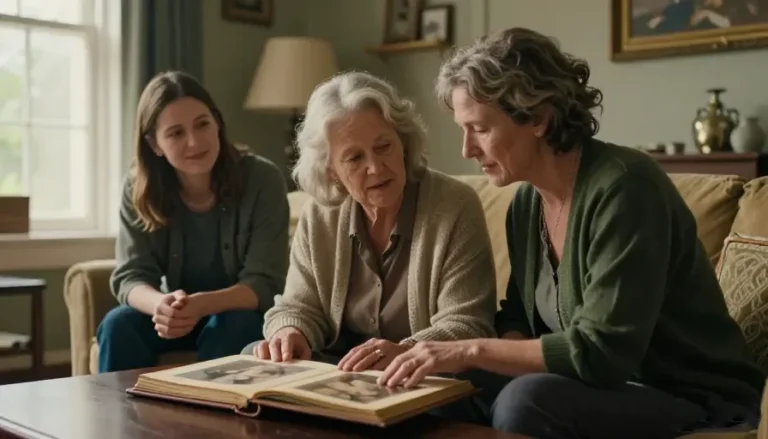
For most of human history, family stories were carried in voices, in handwriting, in objects passed down. Today they’re also carried in cloud storage, half-forgotten hard drives, and social media posts that vanish in algorithms. AI isn’t replacing those voices – it’s giving them a better chance to survive the next generation.
Here are five ways the technology is already shifting how families keep their past alive, and why that matters.
1. Handwriting and dialect are no longer barriers
Old letters, diaries, recipe cards — many families have boxes full of handwriting they can no longer read easily. Cursive from the 1950s, regional spellings, faded ink. Until recently, transcribing meant hours of careful typing.
Modern AI can now read most handwritten documents with high accuracy, even when the script is idiosyncratic or the paper is damaged. It doesn’t just turn ink into text – it understands context: “Mamie’s galette” becomes “grandmother’s galette des rois”, and the regional variation is noted rather than standardised.
Why it matters: the words stay in the voice they were written in. A child in 2026 can read her great-grandmother’s letter exactly as it was set down in 1958 – accent, spelling, feeling intact.
2. Scattered photos become connected stories
A shoebox of loose photographs, a phone full of unsorted scans, a Facebook album from 2012 – most family collections are fragmented across time and devices.
AI can now recognise faces, places, clothing styles, even approximate dates from visual clues. It suggests connections: this woman in the 1970s wedding photo is the same person holding a baby in the 2001 snapshot. It doesn’t invent relationships, but it surfaces possibilities that would take humans weeks to spot.
Why it matters: the collection stops being a pile of objects and becomes a beginning of a story. The gaps don’t disappear – they become invitations for family members to add context.
3. Oral recordings turn into searchable timelines
Grandparents’ voice notes, recorded interviews, old cassette tapes – spoken memory is rich but hard to navigate. Searching “Grandad’s story about the war” meant listening through hours of tape.
Speech-to-text models have improved dramatically. They transcribe with good accuracy even in accented or elderly speech, and more advanced systems extract entities (people, places, dates, events) to build timelines automatically.
Why it matters: a single afternoon conversation can become a navigable record. A grandchild can later search “when did Grandad live in Higham?” and find the exact minute the answer was given.
4. Private digital memorials replace fragile boxes
Paper fades. Hard drives fail. Public family trees on commercial sites often become data commodities. The alternative is a private, encrypted digital space where memories live securely and remain under family control.
New tools allow users to create personal memorial pages – searchable, linkable within the family, never public unless explicitly shared. No third-party monetisation, no forced visibility.
Why it matters: dignity. A grandmother’s stories don’t become advertising fodder. They stay intimate, permanent, and owned by the people who loved her.
5. Younger generations feel closer to ancestors they never met
A 20-year-old today rarely hears family stories in person the way previous generations did. But when those stories are structured, searchable, enriched with context, the distance shrinks. A teenager can read her great-grandfather’s war letter, see the map of where he was stationed, hear a cousin’s voice note explaining the family joke in the margin.
AI doesn’t replace human telling – it amplifies it. It makes the past accessible in ways that fit modern life.
Why it matters: connection across time. Not abstract ancestry, but real people with real voices.
These changes are not about replacing memory – they’re about giving it a better chance to endure in a world where so much is designed to disappear.
If you’d like to see these tools in real life, join the Briogh community. We’re building something private, thoughtful, and human – and we’d love to have you with us.