
The box had sat untouched in the attic for twelve years.
When Claire finally carried it downstairs one rainy Saturday in November, she expected dust and perhaps a few old photographs. Instead she found a small, fabric-bound notebook tied with frayed kitchen twine. On the front, in careful copperplate handwriting she hadn’t seen since childhood: Recettes de Mamie – 1952–1987.
Inside were seventy-three pages of recipes, notes, crossings-out, stains from olive oil and red wine, little drawings of herbs in the margins. Her grandmother’s life in food, written between raising five children and running a small village bakery in rural France.
Claire’s first thought was practical: scan the pages before they disintegrate. Her second thought was heavier: once scanned, what then? A PDF folder on a hard drive somewhere? Another thing that would be opened once and then forgotten?
She remembered a conversation with a friend about a new AI tool called Fisceal, built by a small UK company called Siorai Labs. They said it didn’t just digitise — it understood. Claire decided to try.
She photographed each page with her phone under good daylight, uploaded the forty-odd images to the private test instance they had been given access to, and waited.
Less than ten minutes later the system returned something she hadn’t expected: not only clean, searchable text, but context.
Fisceal had recognised that “une poignée de farine” was not a vague instruction but a common 1950s rural measure (roughly 120–150 g depending on the baker’s hand). It identified the origin of “tourtière landaise” as the Pays des Landes, in France, cross-referenced the use of armagnac with local recipes from the same decade, and even noted that the frequent mention of “Marie” referred to Claire’s aunt, born 1954 — whose birthday cake recipe appeared three times with small variations.
Most surprisingly, it built a simple timeline. The earliest dated recipe was a galette des rois from January 1953. The last, dated 1987, was a chocolate mousse “pour les petits-enfants”. Between those dates Fisceal had quietly mapped twenty-nine family birthdays, eight Christmas dinners, and the approximate years when the family moved from one village to another.
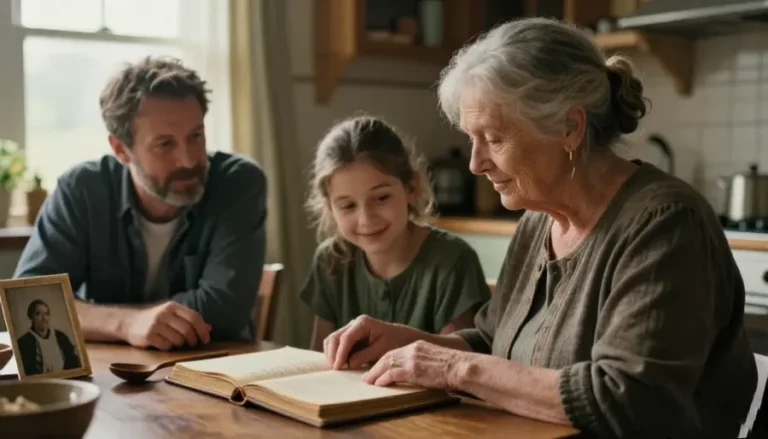
Claire’s mother, who had flown in from Montreal, sat beside her as the memorial page took shape.
It was never meant to be public. The page existed only for the family: a clean, searchable digital version of the notebook, linked to a private family tree that Fisceal had begun to sketch from the names and dates mentioned in the margins. There were gaps, of course — Fisceal never invents — but it suggested research directions: census records for a great-uncle named in a note about a harvest festival, a 1960s bakery licence record that matched the address Mamie wrote on the inside cover.
The real moment came when Claire’s teenage daughter added a photograph she had taken the previous summer: her own hands making the same galette des rois, following the recipe exactly as written in 1953. Fisceal linked the photo to the original page. Three generations now shared the same kitchen instruction across seventy years.
The food wasn’t just food anymore. It was continuity.
A few weeks later the notebook went back into its box — but now it had a companion: a private link that any family member could open from anywhere in the world. The ink might fade, but the recipes would not.
We built Briogh so that no memory needs to stay locked in a box or a drawer. Small objects carry large stories. If you have a recipe book, a bundle of letters, or a handful of photographs waiting to be rediscovered, we’d like to help make sure they survive the next generation.
Join the Briogh waitlist to be among the first to try it when we open early access.