
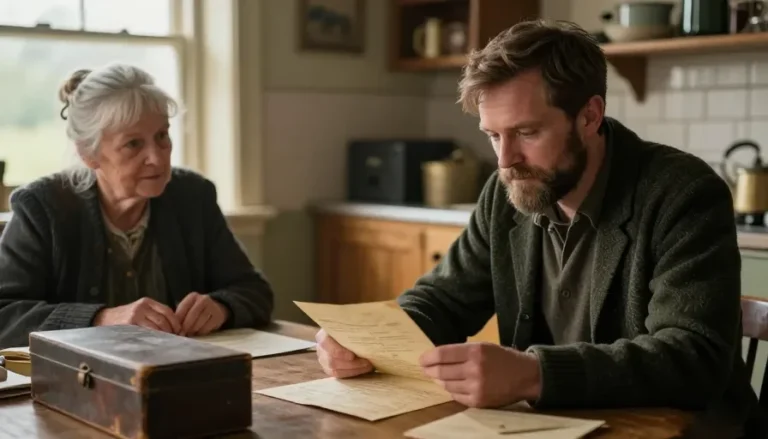
The shoebox was in the back of the attic cupboard, behind a stack of Christmas decorations. I almost didn’t open it — there were too many boxes already. But something about the weight of the cardboard and the faint smell of old paper made me sit down on the dusty floor and lift the lid.
Inside were sixty-seven letters, folded and refolded, tied in bundles with faded ribbon. My grandfather wrote them between 1943 and 1945, mostly to his fiancée (later my grandmother) from North Africa, then Italy. The paper was thin, the ink sometimes faint, the handwriting small and careful.
I knew the letters existed. My grandmother had mentioned them once or twice, always with a quiet smile. But I’d never read them. Opening one felt like trespassing.
The first line of the first letter: “Ma chérie, the sun here is fierce but nothing compared to the thought of seeing you again.”
I read for an hour, sitting cross-legged on the attic boards. Then I decided I wanted to do more than read. I wanted to make sure these words didn’t disappear.
I opened Briogh, the platform Siorai Labs built. I photographed each letter with my phone under good daylight. Sixty-seven pages took about ninety minutes. I uploaded them in batches.
By Saturday morning Briogh had finished processing.
It didn’t just transcribe. It understood.
The letters were in French, with occasional English phrases my grandfather picked up from Allied troops. Briogh handled both. It recognised place names (Sidi Bel Abbès, Monte Cassino, Rome), dates, military ranks. It extracted people: my grandmother’s name appeared 41 times, her sister’s 12 times, a cousin who died in 1944 mentioned twice with grief in the margin.
Briogh built a simple timeline: the first letter postmarked 12 March 1943 from Oran, the last dated 8 May 1945 from Bolzano. Between those dates it mapped movements, battles, and the slow return home.
It also noted emotion. Not in a dramatic way — just quiet observations: “affectionate tone”, “worry about food shortages at home”, “hope after VE Day”.
By Saturday afternoon I had a clean, searchable digital version of every letter. Each page linked to its original scan. Briogh had created a private memorial page: a single, encrypted space where the letters lived together. I added two photographs — one of my grandfather in uniform, one of him and my grandmother on their wedding day in 1946. Briogh linked them automatically to the timeline.
Sunday morning I invited my mother and my sister to the page. They both have access only because I gave it to them — no one else can see it. We read the letters together over coffee. My mother recognised phrases she’d heard as a child. My sister, who never knew her grandfather, read his words for the first time.
The letters weren’t just words anymore. They were a bridge.
The shoebox is back in the attic now. But the letters are no longer trapped in paper. They’re alive, searchable, safe, and private. If I ever want to add more — a cousin’s memory, a new photograph — the space is waiting.
We built Briogh so that no one’s letters, photos, or stories need to stay locked away or lost in time. If you have letters like these — war correspondence, love notes, childhood diaries — you can do the same.
Try Briogh today and start preserving your own family’s story.